The ISA marked a fourfold increase in the number of resolved complaints in favor of insureds
The transparent operation of the ISA management has contributed to the growth of the number of complaints received from insureds regarding the operation of the insurance companies. In three months, the ISA acted upon 52 complaints, which is three times more than last year. The most numerous, in the first three months of this year, are the complaints of insureds for car liability compensation of damage covered by a European report. The number of these complaints increased almost fourfold.
The Insurance Supervision Agency (ISA) in the first three months of this year reviewed 52 complaints from insureds who complained about the services of insurance companies.
The number of complaints that the ISA acted upon in the first quarter of this year has tripled compared to the same period last year when the ISA experts acted upon 17 complaints.
In the period January-March, the ISA received a total of 62 complaints from insureds, whereby 6 of them were without grounds for consideration, and in 4 cases the submitters withdrew their complaints. Out of a total of 52 cases in which the ISA acted in favor of the insureds, 8 complaints were resolved, which is a fourfold increase compared to the same period last year. Currently 18 complaints are being processed, and 26 complaints of insureds were negatively resolved.
Usually, the insureds complained about the European report service when resolving traffic damages. Out of a total of 27 complaints for resolving car liability damage claims (the largest and compulsory insurance class), as many as 19 complaints are due to the actions of insurance companies in accordance with the European report for damages. Compared to the same period last year, the number of insureds who complained about that service increased fourfold.
There has been a significant increase in the number of complaints for property insurance – the largest voluntary insurance class. The ISA experts received 13 complaints from insureds, which is twice as much as in the same period in 2021.
Regarding the reason for which the insureds complain, most of the complaints in this period refer to the basis for payment of damages by the companies. For the first three months, 20 such complaints were received, which is 53% more than the same quarter in 2021.
The most significant increase in the number of complaints is related to the procedure in which companies process the damages of the insureds. From the beginning of January to the end of March, 16 complaints for damage processing were submitted, and last year in the same period there were 4 times fewer submitted complaints on this basis.
In the first three months of this year, 15 insureds complained about the amount of compensation offered by insurance companies. In these cases, the ISA does not have the authority to decide on the amount of compensation, however it determines the conditions and circumstances in which the decision on the amount of offered compensation of damage was made.
Of the submitted complaints, 47 were submitted by citizens, and 15 were submitted by legal entities. Of the citizens who submitted complaints, 13 used the services of a lawyer – representative.
A complaint is submitted to the ISA if the insured is not satisfied with the response to the claim by the insurance company or has not received a response within 30 days. The ISA does not review anonymous complaints or cases for which court or other proceedings are being conducted.
The Insurance Supervision Agency (ISA) is an independent regulatory body that regulates the insurance market, supervises the operation of the insurance entities, ensures protection of the rights of the insureds and contributes to financial education and inclusion of the population.
The 10th edition of Global Money Week will take place from 21 to 27 of March 2022

The Global Money Week takes place on a global level since 2012, with the exception of 2020 due to the Covid pandemic, and as of 2021 it is held and organized by OECD. This global initiative, which takes place in more than 175 countries worldwide, raises the awareness of young people for financial education and increases their knowledge about money, saving, employment and entrepreneurship. Every year, the young people discuss, read and learn about the economic and financial systems through various activities conducted by the financial, national and educational institutions. The purpose of the Global Money Week is to encourage young people to invest in their future by emphasizing the importance of financial literacy and education, thus making them aware of their financial rights, ensuring access to financial services to them and developing their financial skills.
The financial education is integral part of the ISA mission and this year we will be part of the traditional celebration of Global Money Week and promote the financial literacy in our country through events, publications and partnerships. All activities are aimed at improving the financial literacy through better financial education.
The Agency will participate via numerous activities on multiple levels: promotion of useful contents and giving advices to the insured via the education portal with focus on the protection of their rights and interests, sharing useful and timely information via Internet website and social networks, educational questionnaires, surveys, organizing quizzes, educational online lectures, TV events, promotion of the best practices in the domain of financial education and financial inclusion, promotion of the role of the insurance companies and insurance mediators in the financial education in order to become part of their good operation with regards to their financial clients, encouraging accountability and responsibility of the insurance companies and insurance mediators, not only in providing information and advices for financial issues, but also in the promotion of the financial awareness of the clients.
This is an excellent opportunity to include entities with their own activities and ideas on the insurance market!
- https://globalmoneyweek.org/regions/mena/11-partners.html
- https://edukacija.aso.mk/%d1%84%d0%b8%d0%bd%d0%b0%d0%bd%d1%81%d0%b8%d1%81%d0%ba%d0%b0-%d0%b5%d0%b4%d1%83%d0%ba%d0%b0%d1%86%d0%b8%d1%98%d0%b0/
- https://www.globalmoneyweek.org/gmw2022-launch.htmВ
Do not forget to follow ISA profiles on social networks (Facebook, LinkedIn, Instagram)
ISA: The number of complaints resolved in favor of policyholders increased by 83%
The number of complaints filed by policyholders in the first nine months has doubled compared to the same period last year. During this period, based on complaints received from discontented policyholders, the ISA has imposed four measures on three Insurance Companies, two of which are fines
The Insurance Supervision Agency (ISA) has increased by 83 percent the number of complaints resolved in favor of discontented policyholders during the first nine months of this year, in comparison to the same period last year. By the end of September, 22 complaints were resolved in favor of policyholders who were dissatisfied with the insurance companies’ operation, and during the same period last year, 12 complaints were resolved in favor of policyholders.
As of the end of September this year, the ISA received 127 complaints from discontented policyholders. In comparison to the same period last year, when 62 complaints were filed, this year their number has doubled.
14 complaints are in the process of being resolved, and 76 complaints have been resolved in favor of the companies. 12 of the filed complaints were found to be unfounded, and three were withdrawn by the appellants.
Regarding the type of insurance, most complaints – 55 were filed for losses incurred in Auto Insurance (the most common class of insurance that is compulsory by law). 15 of them were resolved in favor of the discontented policyholders. There were 24 complaints filed for claims for losses covered by Casualty Insurance, two of which were resolved in favor of the policyholders. Out of 10 Property Insurance complaints, two were resolved in favor of the policyholders. Five complaints were filed for Health Insurance, and one for each of the following: Crops and Fruit Insurance, Travel Insurance, Kasko Insurance and Financial Loss Insurance. Four complaints were filed for other types of non-life insurance. 13 complaints were filed for Life Insurance, two of which were resolved in favor of the policyholders.
In 50 cases, the reason for the complaint had been the basis for loss payment. In 34 cases, the reason for the complaint had been the amount of compensation (the ISA does not decide on the amount, but considers the circumstances and arguments on the basis of which the compensation is determined).
There are seven complaints about the deadline for loss payment, and the same number complained about the loss processing. Three policyholders complained about the amount of recourse, and two about the response they received from the company to their complaint. 12 more complaints have been filed on other grounds.
Of the total number of filed complaints, 106 have been filed by citizens (natural persons), and 22 by legal entities.
A complaint is filed to the ISA if the policyholder is not satisfied with the response of the insurance company to the claim or if the policyholder has not received a response within 30 days. The ISA does not investigate anonymous complaints or cases for which court or other proceedings are being conducted.
The Insurance Supervision Agency (ISA) is an independent regulatory body that regulates the insurance market, supervises the operation of insurance entities, takes care of the protection of the rights of policyholders and contributes to financial education and inclusion of the population.
The fifth edition of Financial Literacy Days shall be held next week
The fifth edition of Financial Literacy Days shall be held next week, November 1-3, organized by the financial regulatory institutions in cooperation with their financial companies. To be more precise, the organizers of such event are the National Bank, the Ministry of Finance, the Securities Commission, the Agency for Supervision of Fully Funded Pension Insurance – MAPAS and the Insurance Supervision Agency and the private financial sector is also expected to become one of the organizers.
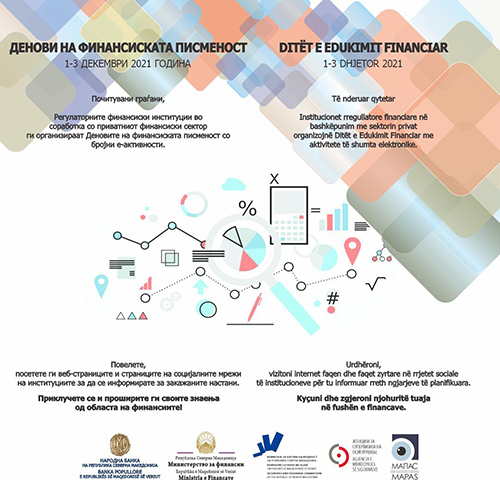
This year, due to the conditions imposed by Covid-19 pandemic, Financial Literacy Days shall be organized primarily as educational lectures via video conference which will allow large number of interested citizens to attend the event. All institutions participating in this year’s edition will inform the citizens via their websites and social network pages about the planned activities and e-events, also notifying about the registration method for every interested citizen.
The financial regulatory institutions ask the citizens to monitor the information about the planned activities and to be actively included in this year’s edition of Financial Literacy Days. The purpose of this action is to strengthen the financial education, encourage financial inclusion and raise the awareness and protection of the users of financial services.
In the course of the year, the financial regulatory institutions implemented most of the planned activities in the sphere of financial education and financial inclusion, while being adjusted to the conditions of the “new normal”. Additional strengthening of such activities is expected in the forthcoming period, considering the commenced implementation of the first National Strategy for Financial Education and Financial Inclusion, adopted in July this year by the financial regulators.
The number of paid damage increased by 15% i.e. EUR 31.5 million were collected by the insured.
In the first six months of this year the insurance companies paid the total of 35,163 damages for non-life insurance, whereby the insured collected EUR 31.5 million i.e. 20% more than last year. The private health insurance has the highest increase of paid damage i.e. by 68% compared to the same period last year.
In the first six months of this year the insured collected 35,163 damages from the insurance companies. That is 15% increased number of paid damages for non-life insurance compared to the same period last year. In the first six months of this year, 11 insurance companies for non-life insurance paid damages in the total amount of MKD 1.94 billion (EUR 31.5 million). The aforementioned shows an increase by 20% compared to the first six months in 2020, as presented in the official data of the Insurance Supervision Agency (ISA).
The highest increase of the number of paid damages in this period is recorded in the private health insurance – class with the highest increase during the health pandemic caused by the COVID 19 virus. In the period January – June this year, the total of 9,144 damages covered with insurance contracts were paid, i.e. there is an increase in the number of paid damages by 68% compared to the same period last year. In the first six months of this year, the insured collected the total of MKD 92.6 million (EUR 1.5 million) for private health insurance coverage.
With regards to property insurance, the highest class of voluntary insurance according to the value of investments in policies, the total of 4,022 damages were paid for six months. That is an increase by 3% compared to the same period last year. Based on such damages, the insured collected MKD 292.1 million (EUR 4.75 million).
With regards to the most used voluntary class – accident insurance, the total of 3,573 damage claims were paid, i.e. same as last year. The value paid by the insurance companies to the insured amounts in MKD 249.4 million (EUR 4.05 million).
Based on Casco insurance for motor vehicles, 3,661 damages were paid i.e. by 3% less compared to last year. The insurance companies paid MKD 224.1 million (EUR 3.6 million) to the insured for such damages.
As expected, the highest number of paid damages is for the legally mandatory car liability insurance. The total of 13,603 damages were paid with regards to the aforementioned, which is by 19% more compared to the same period in 2020. The value of the paid damages in this insurance class for this period amounts in MKD 875.9 million (EUR 14.24 million).
The Insurance Supervision Agency (ISA) is an independent regulatory body which regulates the insurance market, supervises the operation of the insurance entities, takes care of the protection of the rights of the insured and contributes to financial education and inclusion of the population.